Best of Boston newspaper article
It Ends with UsThe Best of Boston newspaper article is a deceptively simple object—an annual people's choice feature in a Boston paper—that nevertheless functions as one of the novel's most potent engines of plot and emotion. It appears twice, and each appearance pivots the story on a different axis: the first time it delivers professional triumph and marital happiness; the second time it delivers a revelation that shatters both. The article is the material link between Lily Bloom's present life with Ryle Kincaid and her buried past with Atlas Corrigan, and its second reading is the spark that sets the novel's most violent scene into motion.
The First Reading: Professional Validation
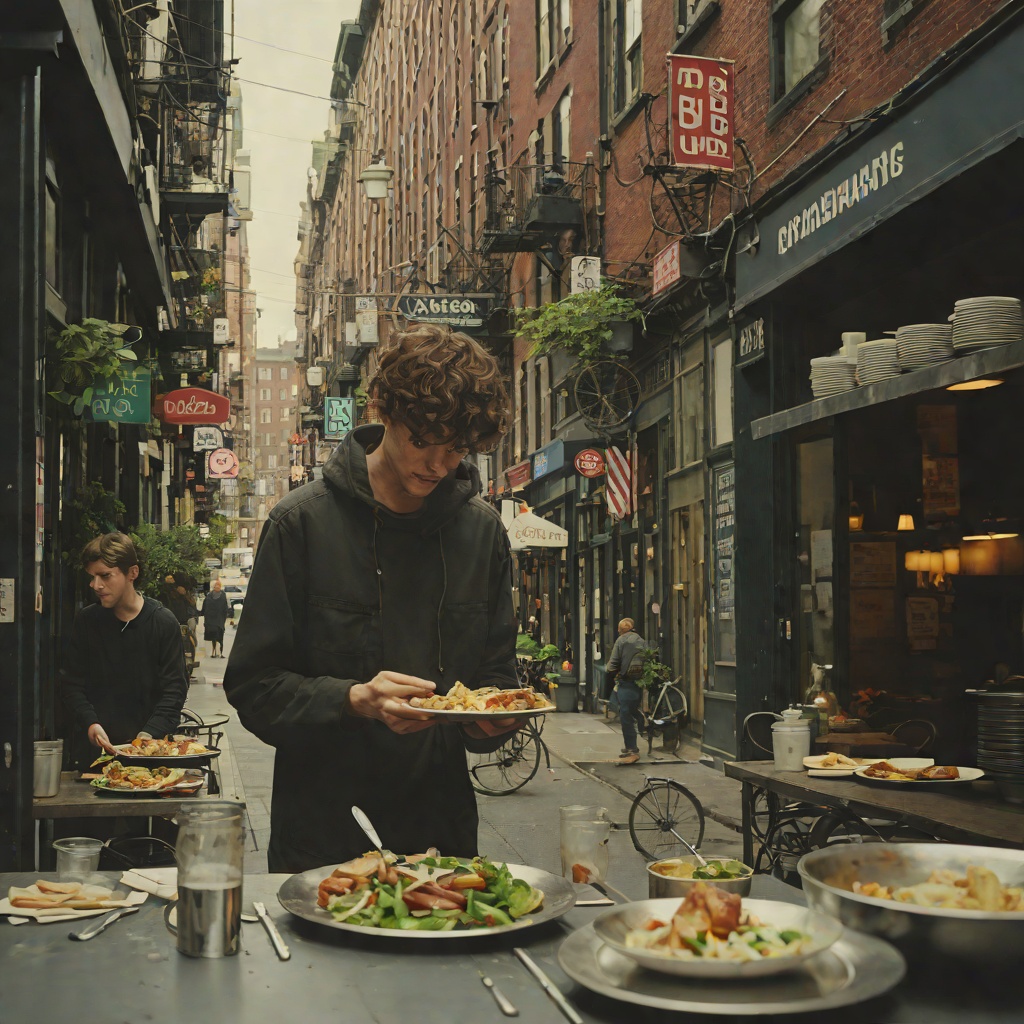
Ryle Kincaid bursts into Lily Bloom's floral shop one evening carrying two coffees and a newspaper folded inside-out, his face lit with a frenzied, urgent smile. He shoves a coffee into Lily's hand and points at the article, announcing, "You got it, Lily. You got it!" The piece is the newspaper's annual people's choice feature, headlined "Best new businesses in Boston. Votes are in for your top ten!" Lily's shop has been nominated under the "Best new businesses in Boston" category, a distinction reserved for businesses open less than two years. She had suspected the honor might be coming after a reporter called her the previous week with a series of questions, but the confirmation still lands as a shock. Ryle's joy is physical—he pulls her in, picks her up, and spins her around, nearly making her spill her coffee. The moment is pure, uncomplicated happiness, a snapshot of the marriage at its best, before the violence that will define it. The article here is a trophy, proof that Lily's independent venture—her own name on a shop of her own—has been recognized by the city she chose for herself.
The Second Reading: The Revelation of Bib's
Ryle, having had too much to drink, insists Lily read the last few paragraphs of the same article, and the tone shifts instantly. The passage describes the business with the highest number of votes: "The iconic Bib's on Marketson opened in April of last year, quickly becoming one of the highest rated restaurants in the city, according to TripAdvisor." The owner is identified as Atlas Corrigan, "a two-time award-winning chef and also a United States Marine," and the article reveals what the acronym Bib's stands for: Better In Boston. Lily gasps, clenching her stomach to keep her emotions under control. The article continues with an interview in which the chef finally reveals the true history behind the name: "'It's a long story,' Chef Corrigan stated. 'It was an homage to someone who had a huge impact on my life. Someone who meant a lot to me. She still means a lot to me.'" When asked if the girl was aware he had named a restaurant after her, the article reports, "Chef Corrigan smiled knowingly and said, 'Next question.'"
Lily puts the newspaper down and says she does not want to read anymore, her voice cracking. Ryle, now loud and angry, grabs the paper and finishes the passage himself. The article never names the woman, but Lily knows it is her, and the knowledge that Ryle has somehow put two and two together makes her nauseous. She pushes past him and walks quickly toward the bedroom, overwhelmed by the collision of her past and present. The same object that hours earlier had been a source of shared joy has become a weapon—not because the article itself is malicious, but because it forces into the open a truth Lily has kept buried: that Atlas still loves her, and that she still carries him with her.
The Catalyst for Violence
The article's second reading is not merely an emotional shock; it is the direct trigger for the novel's most harrowing act of violence. Ryle's anger, fueled by alcohol and jealousy, curdles into something far darker. He has read Lily's journals—the Ellen Diaries—and the article has confirmed what those pages suggested: that Atlas was not just a childhood friend but the love of Lily's life. In the aftermath, Ryle's assault is brutal and specific. He comes up behind Lily, slides a hand up her stomach, and takes firm hold of her breast. His fingers trace across her skin to her shoulder, and he slowly runs his finger over the heart tattoo there—the mark of Atlas—before sinking his teeth into her collarbone so hard that she screams. The pain rips through her shoulder and down her arm as she sobs and pleads, "Ryle, let me go. Please. Walk away." The article, an inert piece of printed paper, has become the occasion for Ryle to punish Lily for a past she never denied having. It is the object that converts his suspicion into certainty and his certainty into violence.
The Aftermath and the Pattern of Abuse
The violence set off by the article follows a pattern Lily's mother, Jenny Bloom, later describes with devastating clarity. Jenny explains that every incident chips away at a person's limit, and every time a woman chooses to stay, it makes the next time that much harder to leave. She recalls her own marriage to Andrew Bloom: the first time he hit her, he was immediately sorry and swore it would never happen again; the second time, he was even more sorry; the third time, it was more than a hit—it was a beating; and the fourth time, it was only a slap, and she felt relieved, thinking, "At least he didn't beat me this time. This wasn't so bad." The article-driven assault is Lily's own fourth incident, the one that finally forces her to confront the arithmetic of abuse. After Ryle's attack, Lily flees to Atlas's apartment, the very man whose existence triggered the violence, and hides there, knowing Ryle could track her through a credit card charge at a hotel, or find her at her mother's, at Allysa's, at Lucy's, or even at Devin's. She feels guilt and shame for running to Atlas, as though her calling him lends credibility to Ryle's anger, but she also feels safer there than anywhere else—Atlas has an alarm system. The article, which began as a celebration of two successful Boston businesses, ends as the hinge on which Lily's decision to leave Ryle turns.
The Article as Narrative Device
The Best of Boston article is a masterful piece of narrative engineering because it concentrates in a single object the novel's central tensions: class, memory, and the impossibility of escaping the past. The article's first appearance celebrates Lily's upward mobility—her shop, her name, her place in Boston's commercial life—while its second appearance reveals that Atlas, once a homeless boy living in a condemned house, has risen even higher, becoming a two-time award-winning chef and a United States Marine. The contrast is stark and deliberate. Lily's early journals record her vow never to respect rich people who spend money on materialistic things rather than helping others, a judgment born of watching Atlas go hungry. Now the same newspaper that validates her own success also validates his, and the symmetry is unbearable. The article forces Lily to see that her two lives—the one with Ryle and the one with Atlas—are not separate at all, but braided together by the city they both chose. And it forces Ryle to see that he was never the only man in her story. The article is, in the end, a confession in print: Atlas named his restaurant for her, and he told the whole city before he ever told her.